
Reading time
8
min read
Date
Written by
Rich Roginski (Founder)

Bigger Isn't Better: The Real Cost of Complexity in Healthcare Marketing
Bigger agencies. Bigger networks. Bigger delays. Research shows every day of delay costs ~$500K in lost drug sales. Here's what that means for your next launch.
Bigger Isn't Better: The Real Cost of Complexity in Healthcare Marketing
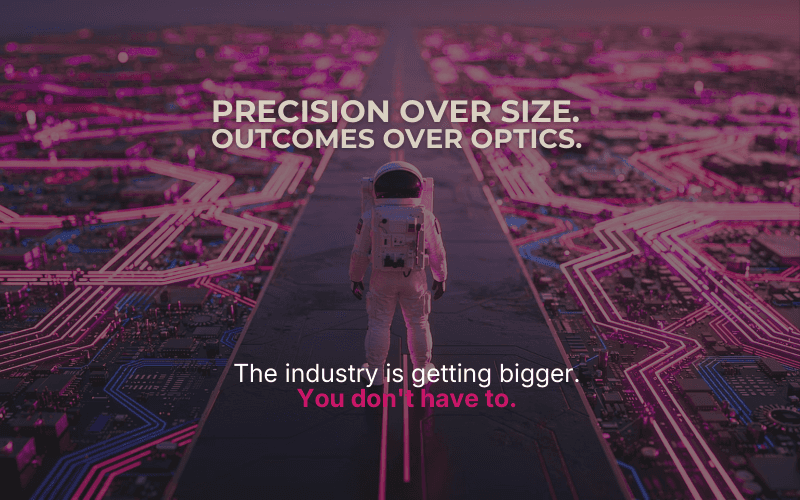
The industry is getting bigger.
Bigger agencies. Bigger networks. Bigger systems built to manage complexity.
That's the pitch, anyway. Scale solves everything. More resources, more reach, more firepower. And on paper, it makes sense. Why wouldn't bigger be better?
Because in healthcare, complexity doesn't stay abstract. It slows decisions that affect real people. It fragments accountability. It puts more space between insight and action. And every delay has consequences.
We made a whole video about it. Watch it, then keep reading. The data backs up every word.
The $500,000 Day
You've probably heard the claim that a delayed drug launch costs $4 million per day in lost sales. That number has circulated in pharma boardrooms for decades. According to researchers at Tufts University, it's wrong.
In 2024, the Tufts Center for the Study of Drug Development analyzed 645 drugs launched since 2000 and published their findings in Therapeutic Innovation & Regulatory Science. The updated number: approximately $500,000 per day in unrealized prescription drug or biologic sales. For 4 in 10 drugs assessed, the figure averaged $1 million per day. Phase III trials alone cost approximately $55,716 per day in direct operational costs.
Half a million dollars a day. Not $4 million, but not trivial. Over 30 days, that's $15 million in unrealized sales. Over a quarter, $45 million.
Here's what that has to do with "bigger isn't better": those delays don't all start in the lab. A meaningful portion of the time lost in getting a drug to market sits in the marketing and communications workflow that supports the launch. And inside bigger, more complex agency structures, time doesn't vanish in one dramatic moment. It leaks.
Where the Traffic Jams Form
An estimated 85% of all clinical trials experience delays, and 94% of those are delayed by more than a month.
Some of that is regulatory. Some is patient recruitment. But in the marketing workflow specifically, the delays come from the same place traffic jams come from: too many vehicles trying to move through a system that wasn't designed for speed.
In the BNB video, you watched a single lane road expand into a massive, twisted network of overpasses until traffic ground to a complete stop. That visual isn't just a metaphor. It's a map of what happens inside a large, multi-layered agency operation:
The single lane road is your brief. Clear, focused, one direction.
The expanding network is what happens when that brief passes through account management, then strategy, then creative, then an internal review chain, then media planning, then compliance, then back to account management for client presentation. Each layer is a new overpass. Each handoff is a new merge point.
The gridlock is what your team experiences as "we're waiting on the agency." It's not that anyone stopped working. It's that the system has so many merge points that movement slows to a crawl.
The fender bender from the video (two people arguing between damaged cars) is what happens when feedback gets distorted through three layers of account management. The strategist meant one thing. The account lead communicated something slightly different. The creative team built something that doesn't match what you asked for. Now everyone's standing in the road sorting it out while the clock runs.
This is the cost of complexity. Not malice. Not incompetence. Structure.
Flat Budgets Make the Math Worse
If marketing budgets were growing, you could absorb some inefficiency as the cost of working at scale. But budgets are not growing.
Gartner's 2025 CMO Spend Survey found that marketing budgets have flatlined at 7.7% of overall company revenue for the second consecutive year. 59% of CMOs reported they have insufficient budget to execute their strategy. And heading into 2026, a separate Gartner survey of 174 senior marketing leaders found that budget and resource constraints are the number one challenge for 63% of CMOs.
Here's the part that ties directly to the "bigger isn't better" argument: in that same Gartner survey, 39% of CMOs said they plan to cut agency budgets. The top action they're taking? Eliminating underperforming agency relationships and streamlining agency rosters. And 22% said generative AI has already enabled them to reduce their reliance on external agencies for creative and strategy work.
The market is not moving toward bigger. It's moving toward leaner. Toward fewer layers. Toward partners who can turn flat budgets into faster outcomes.
The Consolidation Paradox
The advertising industry is responding to these pressures by getting... bigger. The logic goes: merge, consolidate, cut overhead through scale.
But Everest Group research flagged a contradiction in that approach. In an era where 67% of CMOs are actively seeking to rationalize their service provider portfolios, adding more agencies under one roof doesn't simplify the client experience. It complicates it. Integration timelines for mega-mergers are expected to span the better part of a decade. During that time, clients experience shifting account teams, restructured processes, and the organizational distraction that comes with any large-scale integration.
That's the paradox at the heart of "bigger isn't better." The industry consolidates to manage complexity, but consolidation creates its own complexity. More overpasses. More merge points. More traffic.
What the Open Road Looks Like
In the Bigger/Better video, there's a moment where the gridlocked highways give way. The twisted overpasses collapse into a single, clean highway. The traffic clears. A vehicle moves with precision, speed, and focus.
That's not fantasy. That's what happens when you remove the structural layers that don't add value to the final output.
In practical terms:
Direct access replaces account layers. When the person presenting the work is the same person who made the work, feedback travels in a straight line. No translation. No distortion. No "let me take that back to the team."
Compliance is built in, not bolted on. In healthcare, regulatory review is non-negotiable. But when the people creating the work understand the regulatory landscape from day one, you eliminate the rework cycle that happens when creative gets built in a vacuum and then gutted in review.
Digital-forward execution compresses production. Digital campaigns can be live in days. When your default approach starts with digital and extends to other channels, your production timeline compresses naturally.
Purpose-built AI tools handle the operational work. Geo-targeting, audience segmentation, compliance pre-screening, content versioning. These are tasks that eat human hours without requiring human creativity. AI handles them faster and more consistently.
None of this requires cutting corners. It requires cutting the layers that weren't adding value in the first place.
The Bottom Line
If every day of delay costs $500,000 in unrealized drug sales, and your current agency structure adds even 10 unnecessary days over the course of a launch campaign, that's $5 million in lost opportunity. Not because anyone failed. Because the system wasn't built for speed.
Bigger isn't better. Faster is. More precise is. More accountable is.
In healthcare, speed isn't a nice-to-have. Faster timelines mean patients get access to treatments sooner. Faster launches mean you capture market position before the window closes. Faster execution means your flat budget stretches further.
The industry is getting bigger. You don't have to.
Precision over size. Outcomes over optics. FutureNova Health | futurenovahealth.com
Sources:
Tufts CSDD, Therapeutic Innovation & Regulatory Science, 2024. PubMed
Everest Group. Everest Group
Gartner 2025 CMO Spend Survey. Gartner
MESM, citing Nature analysis and Clinithink data. MESM